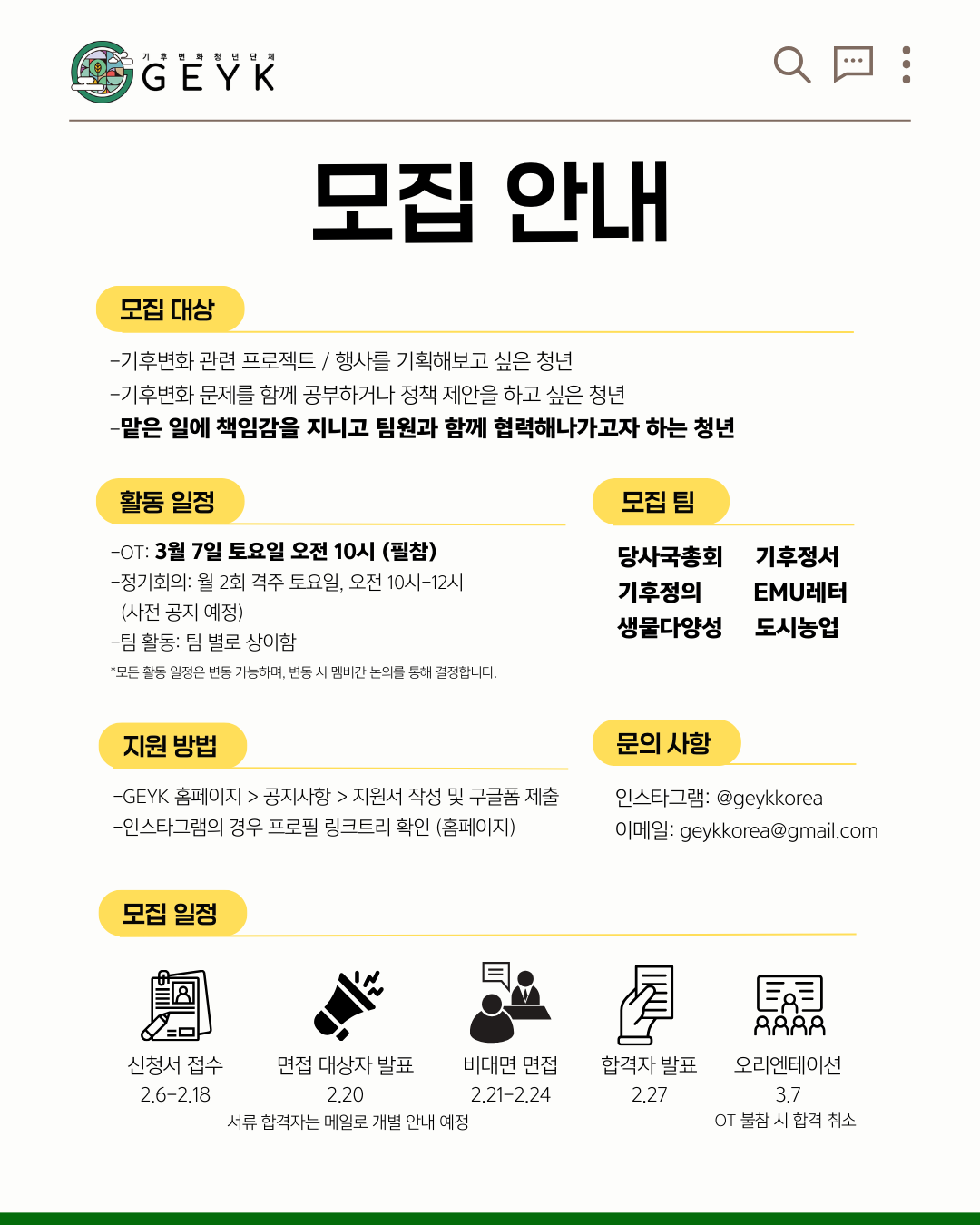
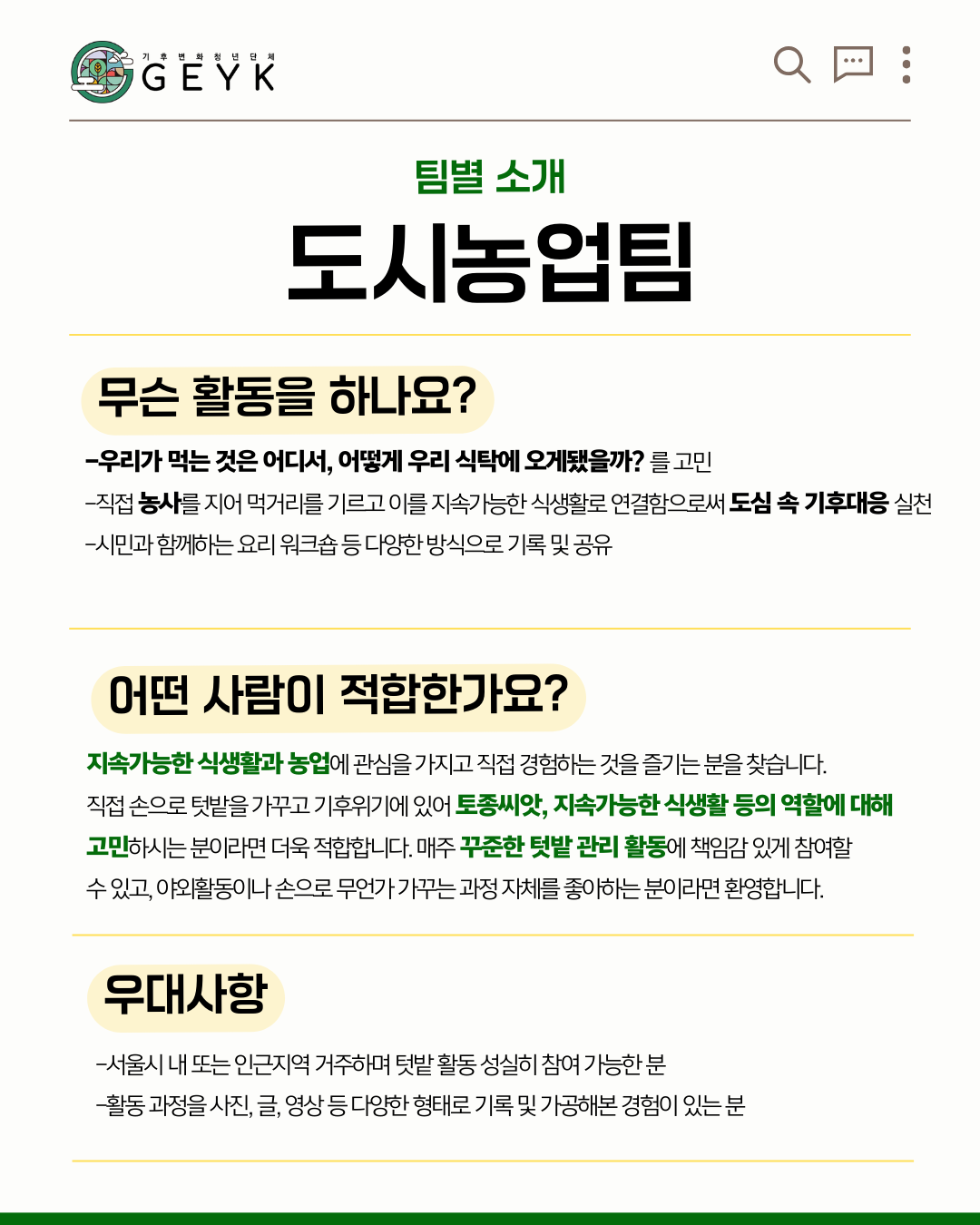
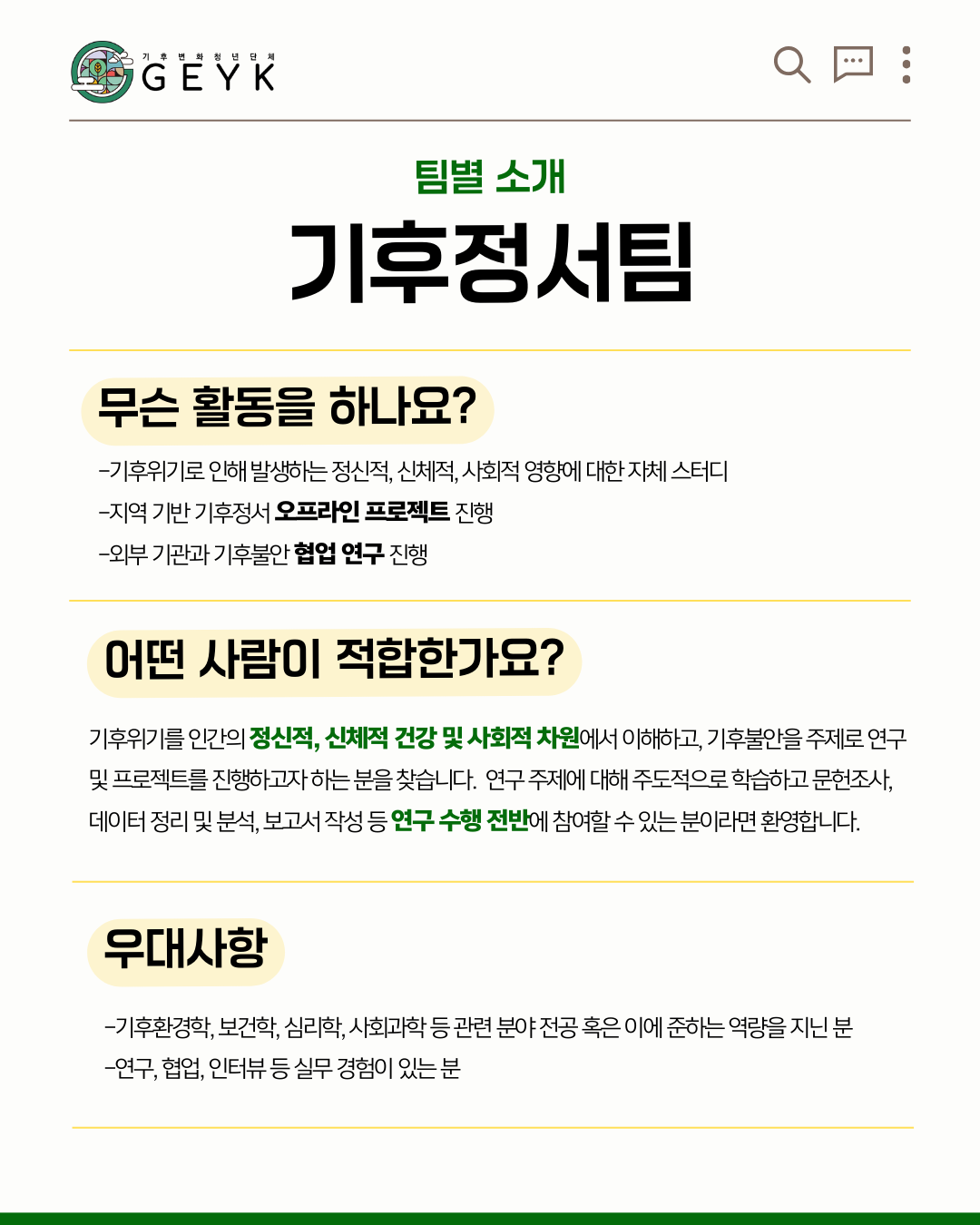
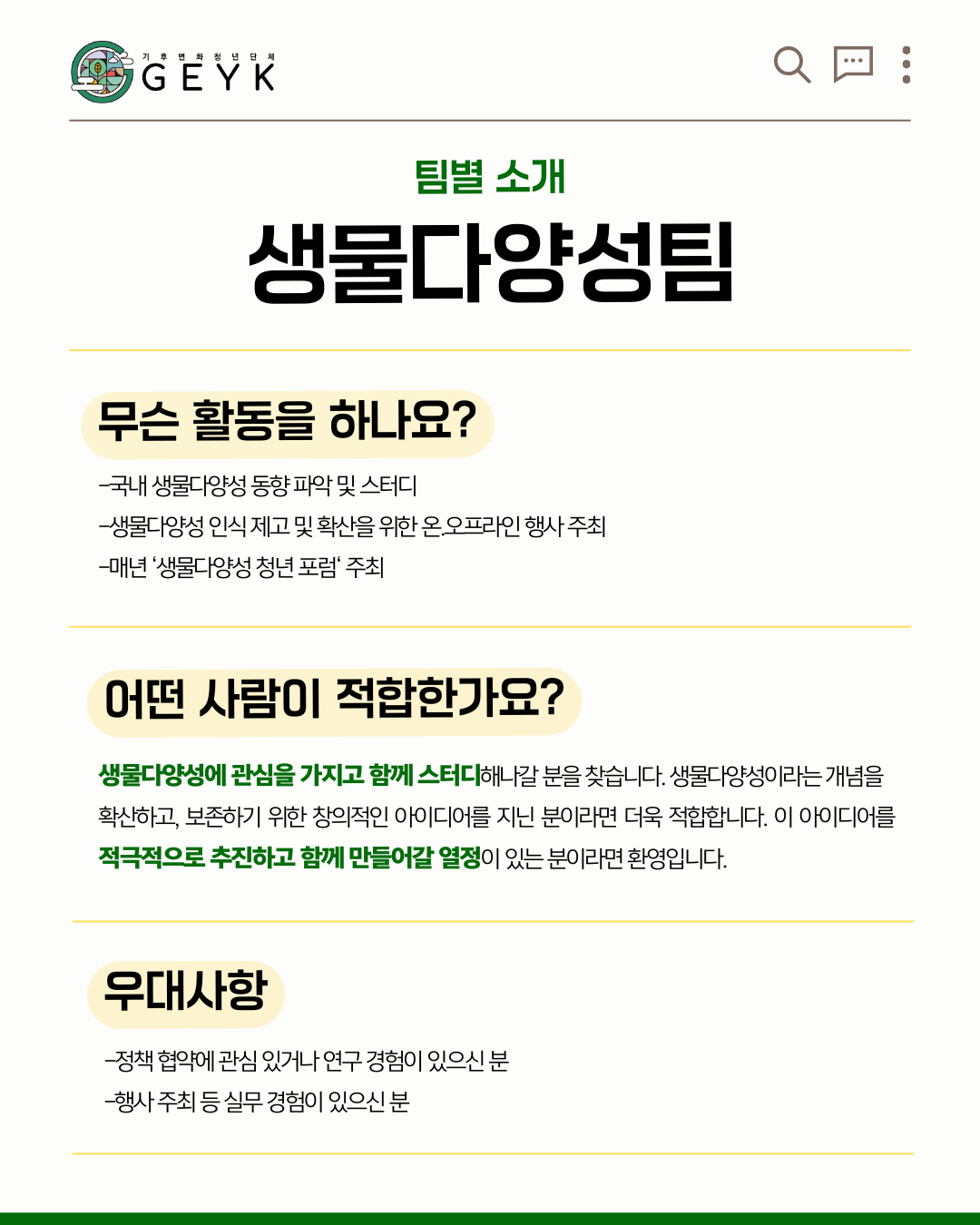
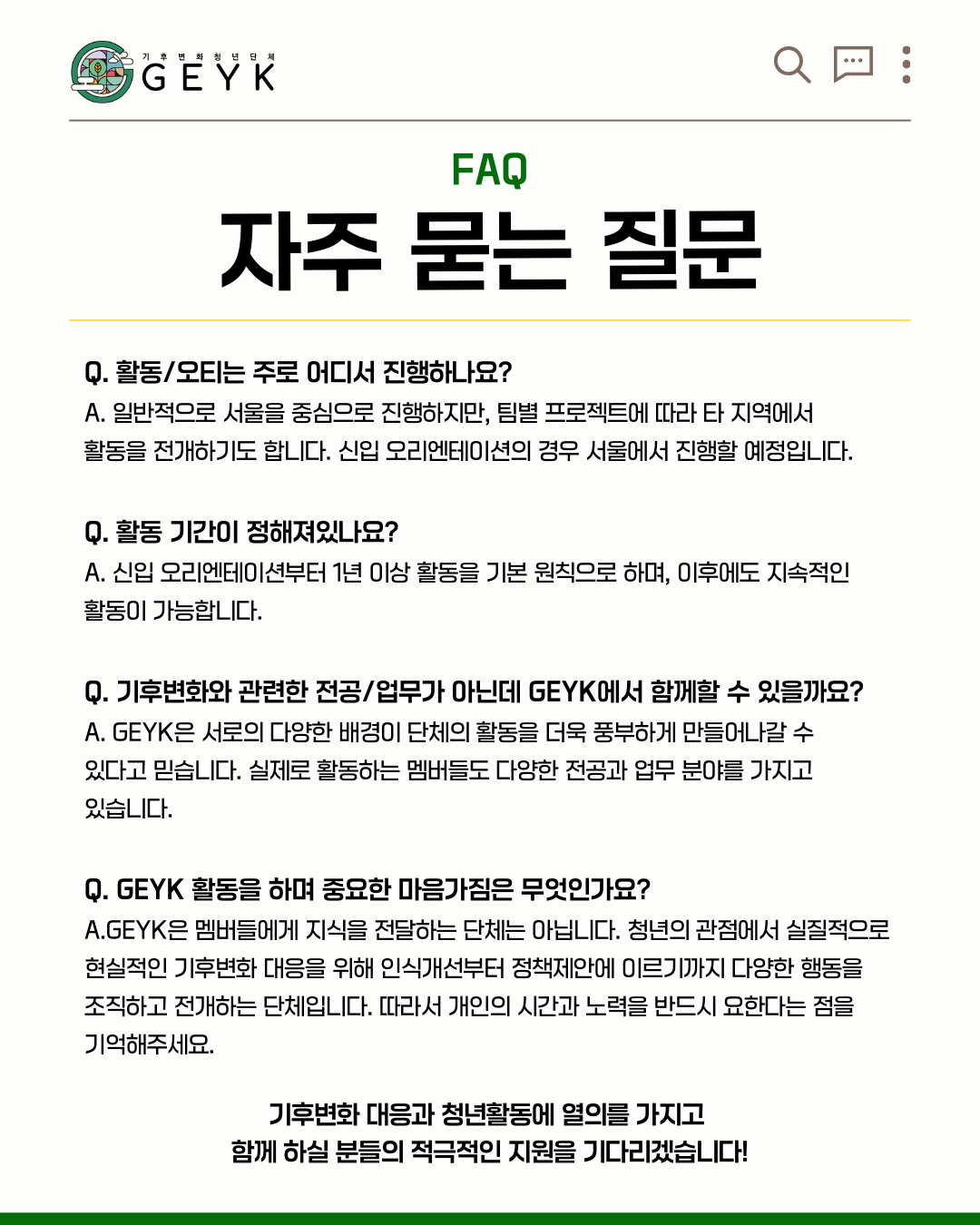
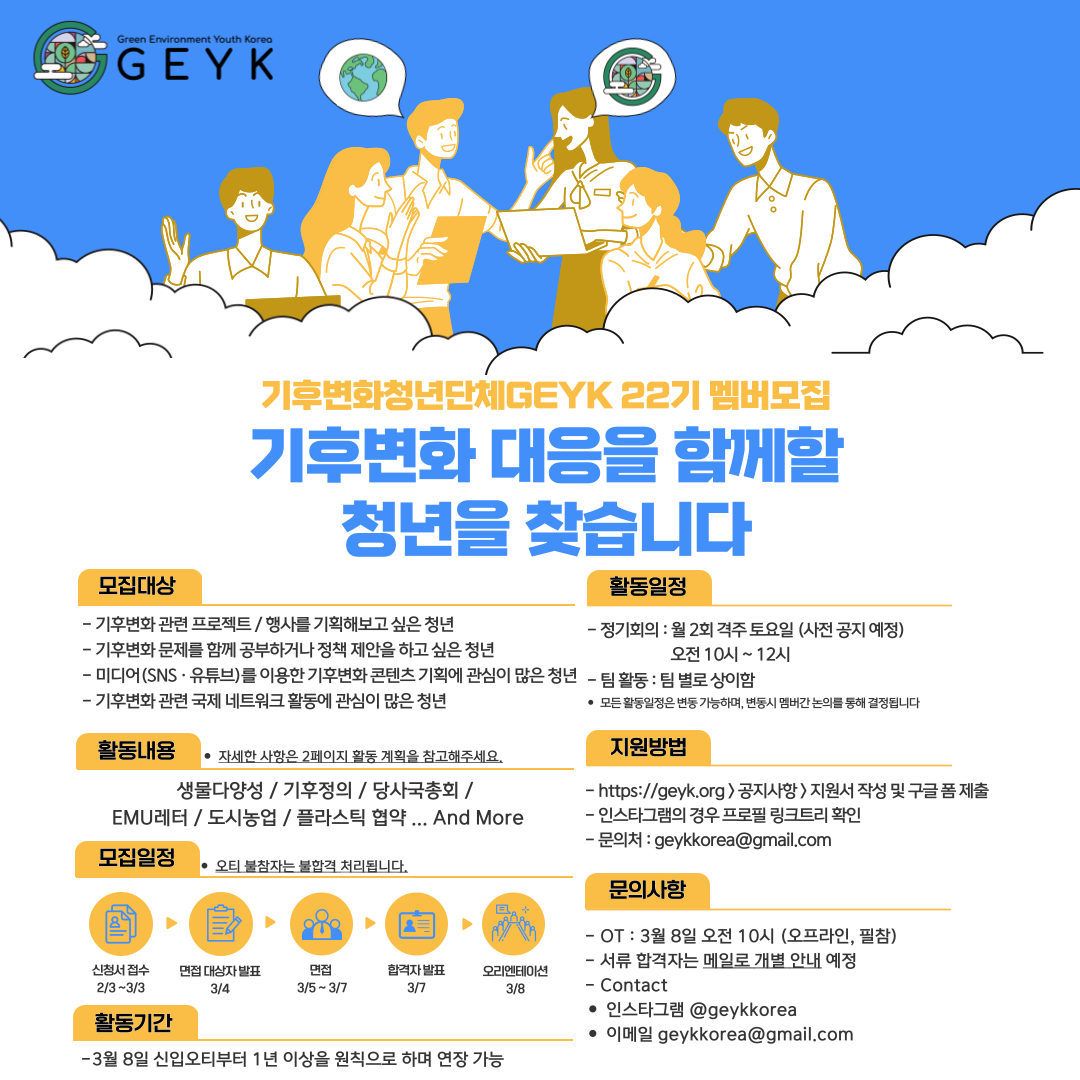
기후변화청년단체GEYK의 22기 멤버를 모집합니다!


기후변화청년단체GEYK (Green Environment Youth Korea, 긱)은 전 지구적 이슈인 기후위기에 적극적으로 대응하고 지속가능한 미래를 만들기 위해 활동하는 청년단체 입니다.

기후위기를 우리 세대에서 마무리 짓겠다는 비전을 바탕으로 다양한 기후변화 분야에 관한 정책 제안과 캠페인 활동, 국내외 네트워크와의 협력 및 행사 기획, 뉴스레터 등의 미디어 컨텐츠 생산, UNFCCC 당사국 총회 참관 및 후속 행사 진행 등의 다양한 활동을 수행하고 있습니다.

GEYK과 함께 기후위기 해결의 실마리를 모색하고, 지속가능한 미래를 찾아갈 22기 멤버를 모집합니다.

1. 모집일정

▶서류접수 : 2025년 2월 3일(월) ~ 3월 3일(월)
▶서류 합격자 안내 : 3월 4일(화)
▶면접 : 3월 5일(수) ~ 3월 7일(금)
* 면접 시간은 서류합격자와 함께 최대한 조율을 진행하나, 경우에 따라 임의로 결정될 수 있습니다.
▶최종 합격자 안내 : 3월 7일 (금)
▶신입 OT : 3월 8일(토) 오전 10시, 서울 (장소 추후 공지)
– 신입 OT 불참자는 불합격 처리됩니다

2. 지원 방법

1) 지원서를 다운로드 및 작성 (GEYK_활동멤버_22기지원서)

2) 해당 링크를 통해 구글 폼 작성

3. 문의

리크루팅에 관한 문의는 인스타그램 DM, 메일을 통해 부탁드립니다.

– 인스타그램: @geykkorea
– 이메일: geykkorea@gmail.com

기후변화에 열정 있는 모든 분들 환영합니다!🤗

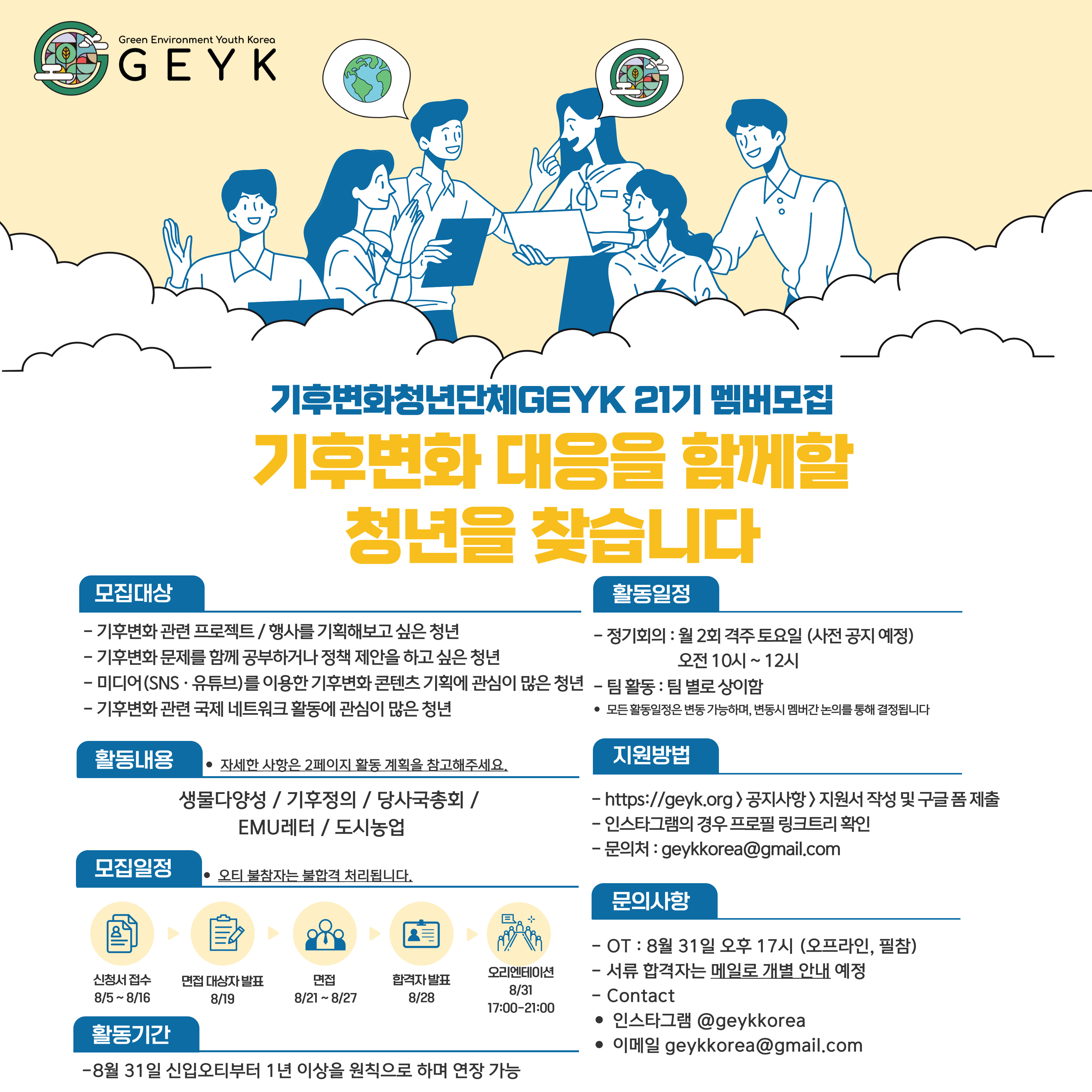
기후변화청년단체GEYK의 21기 멤버를 모집합니다!


기후변화청년단체GEYK (Green Environment Youth Korea, 긱)은 전 지구적 이슈인 기후위기에 적극적으로 대응하고 지속가능한 미래를 만들기 위해 활동하는 청년단체 입니다.

기후위기를 우리 세대에서 마무리 짓겠다는 비전을 바탕으로 다양한 기후변화 분야에 관한 정책 제안과 캠페인 활동, 국내외 네트워크와의 협력 및 행사 기획, 뉴스레터 등의 미디어 컨텐츠 생산, UNFCCC 당사국 총회 참관 및 후속 행사 진행 등의 다양한 활동을 수행하고 있습니다.


GEYK과 함께 기후위기 해결의 실마리를 모색하고, 지속가능한 미래를 찾아갈 21기 멤버를 모집합니다.

1. 모집일정

▶서류접수 : 2024년 8월 5일(월) ~ 8월 16일(금)
▶서류 합격자 안내 : 8월 19일(월)
▶면접 : 8월 21일(수) ~ 8월 27일(화)
* 면접 시간은 서류합격자와 함께 최대한 조율을 진행하나, 경우에 따라 임의로 결정될 수 있습니다.
▶최종 합격자 안내 : 8월 28일 (수)
▶신입 OT : 8월 31일(토) 오후 5시, 서울 (장소 추후 공지)
– 신입 OT 불참자는 불합격 처리됩니다

2. 지원 방법

1) 지원서를 다운로드 및 작성 (GEYK_활동멤버_21기지원서)

2) 해당 링크를 통해 구글 폼 작성

3. 문의

리크루팅에 관한 문의는 인스타그램 DM, 메일을 통해 부탁드립니다.

– 인스타그램: @geykkorea
– 이메일: geykkorea@gmail.com

기후변화에 열정 있는 모든 분들 환영합니다!🤗

[GEYK 9주년 & 제53회 지구의 날 기념 ] NG Dongmyo Fleamarket: 우리는 기후위기를 거스르지

GEYK 창립 9주년과 제53회 지구의 날을 기념하여, < NG* Dongmyo Fleamarket: 우리는 기후위기를 거스르지> 행사를 개최합니다!

지구의 날 당일인 4월 22일 오후 1시부터 서울 용산구 한남동의 소담상회 네모관에서 열리는 본 행사는 GEYK이 추구하는 여러 가지 가치 중에서도 기후변화 대응에 대한 장벽을 낮추고 인식을 높이는 데에 초점을 맞추어 진행될 예정입니다.

행사는 크게 4개 구역으로, 제로웨이스트 및 친환경 라이프를 지향하는 소상공인들이 운영하는 팝업 스토어 존, ESG 경영에 앞장서는 미국의 아이스크림 제조회사인 ‘벤앤제리스(Ben & Jerry’s)’ 와 함께하는 아이스크림 존, GEYK 멤버들의 물건들을 직접 판매하고 수익금은 기부하는 동묘 존, 그리고 ‘기후변화에 대응하는 방법’에 관한 전시와 참여형 체험 공간, 기후네컷 포토부스 등이 있는  체험 존으로 나뉩니다.

구체적인 행사 구성으로는 ▷ 책 <기후피해세대를 넘어 기후위기세대로>의 저자 이재형 박사와 함께하는 ‘기후위기 북 토크’ ▷벤앤제리스와 함께하는 ‘One Scoop of Peace and Love’ 프리콘 이벤트 ▷기후변화를 이겨내는 8가지 방법 전시 ▷지구샵, 사각사각, 하이메, 한바랄 출판사 등 제로웨이스트 • 친환경 지향 업체들의 팝업 스토어 ▷GEYK 멤버들이 운영하는 NG 동묘 돗자리 플리마켓 ▷ 빠른 벚꽃 엔딩 ‘기후 네컷’ 포토부스 이벤트 등이 예정되어 있으며, 더 많은 현장 이벤트도 운영될 예정입니다.

참가비는 무료이며, 북 토크의 경우 자리 확보를 위해 사전 신청을 받고 있습니다. 사전 신청자에 한하여 추첨을 통해 도서를 제공하는 이벤트 또한 진행 중입니다. 사전 신청은 해당 링크를 통해 할 수 있습니다.

*NG는 Next Generation(다음 세대)의 약어로, 기후위기 문제 해결을 위해 새로운 길을 개척하는 우리들을 지칭합니다. 행사를 진행하는 GEYK도, 행사에 참여하시는 여러분들도 모두 NG 입니다 🙂

기후변화청년단체GEYK의 17기 멤버를 모집합니다!

[GEYK 17기 멤버 모집]

기후변화청년단체GEYK (Green Environment Youth Korea, 긱)은 전 지구적 이슈인 기후위기에 적극적으로 대응하고 지속가능한 미래를 만들기 위해 활동하는 청년단체 입니다.

기후위기를 우리 세대에서 마무리 짓겠다는 비전을 바탕으로 정책 제안, 국내외 네트워크와의 협력 및 행사 기획, 카드뉴스나 뉴스레터 등의 미디어 컨텐츠 생산, UNFCCC 당사국 총회 참관 및 후속 행사 진행 등의 다양한 활동을 수행하고 있습니다.

GEYK과 함께 기후위기 해결의 실마리를 모색하고, 지속가능한 미래를 찾아갈 17기 멤버를 모집합니다.

1. 모집일정
가. 서류접수 : 8월 3일(수) ~ 8월 14일(일)
나. 서류 합격자 안내 : 8월 21일(일)
다. 면접(오프라인) : 8월 26일(금) ~ 8월 27일(토)
라. 최종 합격자 안내 : 8월 31일 (수)
마. OT : 9월 3일(토)~ 9월 4일(일)

  • * OT는 1박 2일로 진행되며 첫째날인 9월 3일은 필참하셔야 합니다
  • * OT 불참자는 불합격 처리됩니다

2. 지원방법

*지원서 내용 중 “지망 팀”이 수정되었습니다!
8/4/목 이전에 지원서를 다운 받으신 분께서는 (수정) 파일을 다운 받아주시기 바랍니다.
혼란을 드려 죄송합니다.

– 작성한 서류는 PDF로 전환하여 https://bit.ly/GEYK_17thRC 으로 제출

3. 문의
인스타그램 DM 혹은 메일을 통해 부탁드립니다.

인스타그램: geykkorea

이메일: geykkorea@gmail.com

기후변화에 열정 있는 모든 분들 환영합니다!🤗

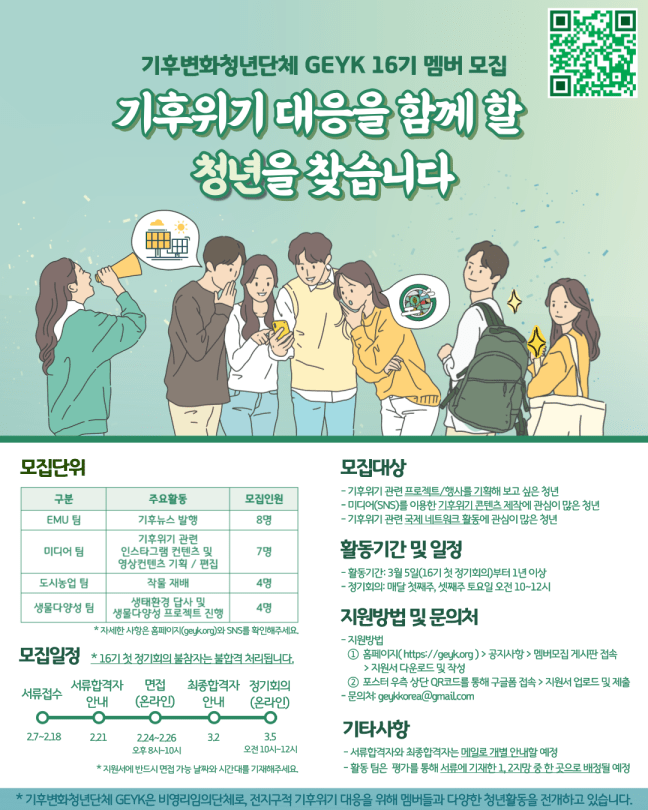
기후변화청년단체 GEYK의 16기 멤버를 모집합니다!

[GEYK 16기 멤버 모집]

기후변화청년단체 GEYK(Green Environment Youth Korea, 긱)은 전지구적 이슈인 기후위기에 적극적으로 대응하고 지속가능한 미래를 만들기 위해 활동하는 청년단체입니다. GEYK은 멤버들과 함께하는 정책 제안, 국내외 네트워크와 협력 및 행사 기획, 미디어를 이용한 콘텐츠(카드뉴스, 뉴스레터 등) 기획, UNFCCC 당사국총회를 참관하며, GEYK의 유수한 멤버 풀을 통해 서로에게 많은 것을 배워가는 곳입니다.

1. GEYK 모집일정
가. 서류접수: 2월 7일(월) ~ 2월 18일(금) 23시 59분
나. 서류전형 합격자 안내: 2월 21일(월)
다. 면접: 2월 24일(목) ~ 2월 26일(토)
라. 최종합격자 안내: 3월 2일(수)
마. OT(필참): 3월 5일(토) 오전 10시 ~12시 (온라인)

* 모집단위는 포스터 내용 확인 부탁드립니다.

* 도시농업 팀의 경우, 최소 1달에 1번 오프라인 모임이 필수입니다.

2. 지원 방법
– 다음의 지원서 파일(GEYK-활동멤버_16기지원서_홍길동)을 다운받아 작성
– 작성한 서류는 pdf로 변환하여 https://bit.ly/geyk_16th_recruiting으로 제출

3. 문의
인스타 스토리 질문통, DM, 메일을 통해 부탁드립니다.

인스타그램: geykkorea

이메일: geykkorea@gmail.com

기후변화에 열정 있는 모든 분들 환영합니다!🤗

[COP26] 탄소중립에 관한 아시아 청년 담론(Asian youth dialogue on carbon neutrality)

“아시아 청년들이 모여 함께 목소리를 내다.”

지난 2021년 11월 10일(수), COP26 Blue Zone 내부 한국 홍보관에서 GEYK의 Side event가 열렸습니다. ‘Asian Youth Dialogue on Carbon Neutrality (아시아 청년들의 탄소중립에 관한 담론)’ 이라는 주제로 열린 이번 행사는 GEYK의 김선률, 대만 TWYCC의 찬청룽과 챠오주린, 홍콩 CCIL의 허미아 찬, 일본 CYJ의 코하나 야나기사와가 패널로 참석하였고 GEYK의 권유정 활동가가 행사를 진행하였습니다.

각국 청년 환경 단체 소속으로 이루어진 패널들은 2050년까지 수행되어야 하는 탄소중립에 대한 각 나라별 정책과 행동계획을 발표하였고, 그러한 정책과 행동의 과정 중에서 청년들이 해야하는 일과 할 수 있는 일, 주목해야 하는 일들에 대해 초점을 맞추어 대화를 이어나갔습니다.

GEYK의 권유정 활동가는 행사를 시작하며 탄소중립의 개념에 대해 간략하게 소개하였고, IPCC 1.5도 보고서의 권고를 충족하기 위해 2050년까지 전 세계의 많은 국가들이 탄소중립을 실현해야 함을 강조하였습니다. 또한 GEYK의 주요 활동에 대한 간략한 소개에 이어 한국 정부가 환경부를 통해 제 1차 미래세대 포럼을 개최하여 청년들과의 더 강력한 대화를 장려하고 있다는 사실을 덧붙였습니다.

한국, 대만, 홍콩, 일본의 패널들은 탄소중립에 관한 각 국의 현재상황을 발표하고 탄소중립에 대한 강력한 열망과 동시에 명확히 마주하고 있는 한계점에 대해서도 이야기를 나눴습니다. 불확실한 기술에 치중된 탄소 중립 계획, 민간 및 공공 부문간의 신뢰 결여, 2050 탄소중립 로드맵의 명확성 결여, 과학적 접근을 기반으로 하는 목표에 대한 지원부족 등이 주요한 문제점이었습니다. 이어 각 패널들은 각국의 탄소중립 정책이나 방향에 대해서 청년들이 해야하거나 하고 있는, 혹은 할 수 있는 일들에 대해 공유했습니다. 예를 들어 한국의 경우 GEYK을 포함한 8개 청년단체들이 발표한 ‘2040 청년들이 제안하는 기후중립 시나리오’가 그것이었고, 대만의 경우 다른 NGO및 의원들과 협력하여 발의한 온실가스 감축 및 관리법 개정안, 홍콩의 경우 FFF의 학교 파업 보호 조정, Local COY 개최, 기후행동 촉구 청원에 대한 청년 연서명, 마지막으로 일본의 경우 각 부처 정책제안과 지역사회 및 교육기관을 대상으로 한 신재생에너지 인프라 설치 촉진 등의 활동을 소개하였습니다.

패널토론은 탄소중립에 대한 정의롭고 포괄적인 전환이 청년들에게 무엇을 의미하는지, 청년들이 탄소중립에 대한 담론에 어떻게 참여하고 행동할 수 있는지, 그리고 탄소중립 활동에 참가함에 있어서 청년들이 그들의 역량을 어떻게 성장시키고 지변을 확대할 수 있을지에 대한 핵심 질문들로 이어졌습니다. GEYK의 김선률 활동가는 “기후위기로 인해 가장 큰 피해를 보는 것은 약자와 소수자들” 이라고 밝히며 “탄소중립에 있어서 정의롭고 포괄적인 접근은 누구도 위기에 먼저 노출되지 않는, 공정한 전진을 필요로 한다. 탄소중립으로의 대 전환이 사회 경제 구조의 포괄적인 변화를 요구하는 만큼 그 과정에서 누구도 소외되어서는 안 될 것이다.” 라고 대답을 마쳤습니다. 이어진 질문에서 CCIL의 허미아 찬 활동가 또한 “기후 문제에 대해 리질리언스를 구축하고, 해결책과 적응계획을 함께 수립하기 위해서는 지역적인 접근이 고려되어야 한다며 지역사회와의 대화가 접근법 중 하나로 평가되어야 한다.”고 강조했습니다. 그 외에도 패널 토론 내내 ‘의미있는 참여’ 라는 말이 계속 사용되었는데, 이는 청년들의 참여를 장려하기 위해, 그리고 그들의 활동이 단발적으로 그치는 것이 아니라, 각 국의, 더 나아가서는 범 지구적인 탄소 중립으로의 흐름에 영향을 끼칠 수 있는 참여를 강조하는 데에 활용되었습니다.

행사가 마무리 단계로 넘어가며 아시아 청년들의 목소리가 국내를 넘어 국제적 수준으로 전달되고 합의될 수 있도록 청년단체간 강력한 협력을 약속했습니다. 행사를 통해 공유된 각 청년들의 경험과 의견들은 청년들이 기후위기에 대해 능동적인 조치를 취해야 하며 어떠한 방식으로 취해야 할지를 분명히 보여주었습니다. 이번 행사를 기회삼아 지속적인 청년들의 네트워크가 형성되고, 이러한 네트워크가 청년으로서 기후위기 문제 해결에 앞장설 수 있는 방안에 기여할 수 있기를 기대하며 행사가 종료되었습니다.

“Small actions are bigger if we cooperate together, through different networks at the youth level”

On 10 November (Wed), GEYK hosted the Asian youth dialogue on carbon neutrality. The following panels followed, Sunryul Kim from GEYK, Chan Cheng Long and Chiao jou Lin from TWYCC, Hermia Chan associated with CCIL, and Kohana Yanagisawa from CYJ. The panels from current working youth environment organizations spoke on behalf of their national governments’ action plans to ensure carbon neutrality by 2050. Moreover, the key focus was to engage a more youth focused dialogue on the current gap from ambition and action made by our government, and as youth what the next steps are to ensure we are headed to the right path for carbon neutrality.

Yoo Jung started the session with a brief introduction on the concept of carbon neutrality, how according to the IPCC report we need to offset the amount of carbon we released into the air by 2050 to secure 1.5 degrees Celsius. Hence many national governments worldwide announced carbon neutrality in their domestic regime. Nonetheless, it should be more than just an announcement, we should ensure we have the next steps our governments needs to take to ensure the announcement is more than just ambitious words. Following a brief introduction on GEYK and its key activities, the effort were shared made by South Korean government to encourage stronger dialogue with the Youth through implementing the first environmental forum with the future generation, hosted by the Ministry of Environment.

The panels from South Korea, Taiwan, Hong Kong, and Japan presented their current situation back home. Despite the strong ambition pledged by the national governments for carbon neutrality, strong setbacks were shown. Such as, the controversy on energy supply on ‘carbon-free gas turbines’, the broken trust among private and public sectors, lack of clarity on the roadmap to secure carbon neutral by 2050, and the lack of plans supported by a scientific based target. Following the clear gap on more action needed to ensure carbon neutrality by the governments, each working youth environment organization share their approaches. For example, in South Korea the ‘2040 Climate Neutral Scenario’ was proposed by the Korean youth including GEYK. In Taiwan, TWYCC cooperated with other NGOs and legislators to propose an amendment act on GHG Reduction & Management Act. Hong Kong also shared their actions such as coordinating the FFF school strike and protect, hosting the Local COY Hong Kong, and proposing a youth statement on the climate action petition. Japan also shared CYJ works such as proposing policies to the ministries and agencies, promoting renewable energy installation to schools and the community, and to take action on including sustainable lifestyle with carbon neutrality.

The panel discussion followed with key questions understanding what just and inclusive transition means for youth regarding carbon neutrality, how youth can be included and engaged in the actions and dialogues, and key learnings on capacity building. Sunryul highlighted that as weak and minority suffer the most, an inclusive approach to a just and fair carbon neutrality transition calls for ‘no one left behind.’ As it requires change in the societal economic structure no one should be alienated in the process. Other comments were made such as how youth should have a stronger understanding to actively take part in the process and dialogue with the decision makers. In addition, Hermia highlighted that dialogue with local communities to build resilience, set up solutions and adaptation plans together should be valued as one of the approaches. As carbon neutrality is not just about the transition but it needs to start dialogue with local communities. The term ‘meaningful participation’ was highlighted throughout the discussion. In order to encourage youth participation, Kohana suggested to arrange more youth focus assemblies and conference authorized by the government, and to encourage decision makers to take risk, regardless of their fear of change. Moreover, Chiao shared to build a clear focus on who the stakeholders are, and what the impacts are, as despite our common identify as youth we have different impacts from climate, and we come from different backgrounds. Then the next step will be to clarify the steps to reach clear and straightforward goals. This structure can be supported by a clear scenario. Sunryul also highlighted that coordination with relevant agencies is important, as it cannot be solved by single stakeholders through individual actions as the process to transition to carbon neutrality is complicated.

The session ended with strong transboundary cooperation among the youth organizations, to ensure youth voices, especially in the Asia region, are delivered at the national and international level. Each learnings, insights, and experience among the youth organizations shared during the session clearly highlighted a common conclusion that while the decision makers need to secure seats in meetings and conferences for youth, youth also need to take a proactive action through strengthening capacity building, building the inter-generation conversation across national borders to maximize our resources and opportunity to ensure our voices are heard, our concerns are reflected, and our demands are taken seriously. Moreover, localizing the happenings in the international setting was also strongly recognized in the session.

GEYK call for action on COP26

2021년 영국 글래스고에서 개최된 제26차 유엔기후변화협약 당사국 총회(COP26)에 참석한 기후변화청년단체 GEYK의 워킹페이퍼 전문.


GEYK call for action on COP26
Drafted by:
Jihye Lee, Yoojung Kwon, Jintaek Woo, Jiwoo Lee, Jiwon Han, Gyeongcheol Kim, Sunryul Kim, Haechan Kim, Jiyun Gim, Jiyae Yim, Yunjoo Cho, Hyejeong Lee


GEYK would like to express our stance on the ongoing Paris Agreement negotiations and agreements, demanding call to action to the stakeholders. The UN Climate Change Conference COP26, should be momentous in the history of climate action recognized as the last chance to avoid catastrophic damage and hold global temperature to 1.5 degree. We highlight that the Paris Rulebook should be finalized under certain emphasis on mitigation, adaptation, finance, and technology transfer, including carbon sinks, market mechanisms, loss and damage, and transparency. We also welcome the inclusiveness for all climate delegates especially for Least Developed Countries(LDCs), Small Island Developing States( SIDS), and other delegates from climate vulnerable countries to ensure all the participants, including registered Parties, admitted observers, and media representatives, are involved in a turning point to build back better and secure a sustainable future.

Article 4: mitigation
We express grave concern that the 2030 Nationally Determined Contributions(NDCs) of each party are insufficient to achieve the 1.5 degree target. Considering that IPCC reports require at least 45% reduction from 2010 levels in greenhouse gases by 2030, we recognize that 2030 NDCs are an important gateway to achieving the 1.5 degree target. Recalling Article 4, we affirm that the NDCs should aim for a clear ‘common reduction target’. The NDCs should be revised by reflecting the scientific based measures and carbon budget, and ensure goals are set through science-based reduction. We welcome the launching of the International Methane Emissions Observatory(IMEO) at the G20 Summit, and highlight world leaders to ensure 30% of methane is reduced by 2030. We strongly urge the Parties to agree on carbon neutrality and phase out coal by 2030. Since coal power generation accounts for a very serious portion of greenhouse gas emissions, coal power generation exit must be carried out first and preemptively. We would like to stress that fossil fuel power generation other than coal also needs to be removed as soon as possible. Fossil fuel power generation cannot be a bridge power source because it essentially emits greenhouse gases. Strong prioritization needs to be made for renewable energy transition. We expect such decisions to be ‘national and therefore responsible and ambitious decisions’.

Article 5: sinks and reservoirs of greenhouse gas
We express deep concern over the ongoing loss and degradation of our sinks and reservoirs of greenhouse gas, including forest and wetlands. We would like to stress that nature plays a crucial role in combating climate change, improves flood protection and provides up to 80% of the world’s terrestrial biodiversity. The essential ecosystem services provided through nature are vital to the livelihoods of more than 1.6 billion people. Expressing our concern on nature conservation and land-use activities, around 80% is due to the conversion of forests to agricultural land.

 Hence, we highlight that bioenergy projects need to be guided through national standardization for complementary and sustainable use, such as EU RED II, as land use contributes to nearly a quarter of global greenhouse gas emissions. Recalling Article 5, we stress all parties to take complementary actions to implement, support and welcome efforts to mitigate climate change through mainstreaming action and global climate finance on nature based solutions, sustainable management of our land use, and ensure timely implementation to transform land use sector carbon neutral by 2040. We urge for due diligence and traceability of land-use management, involving standard tools and techniques such as satellite imagery. We reaffirm to enhance transparency and reporting practices to eliminate deforestation such as fossil fuel subsidies on deforestation. We further welcome addressing scientific and policy facing issues for blue carbon, and urge to strengthen pledges and commitments such as facilitating investment for ecosystems, implementing sustainable agriculture, and strengthening national biodiversity strategies to safeguard biodiversity loss and nature.

Article 6: market mechanisms
We would like to call for the efficient and significant process to reach an agreement on Article 6. Recalling Article 6, we affirm that the market mechanisms would enhance voluntary cooperation in order to significantly reduce carbon emissions. Despite the governments’ strong belief on the importance of the international carbon market to achieve their NDCs, the spread of the global pandemic has inevitably delayed progress in introducing the international emission trading system. Nonetheless, the Parties should take into account key matters on integrity, sustainability, and transparency – especially, in the market mechanisms – as robust accounting rules are needed in order to prevent double counting. Sustainable development mechanism(SDM) also should be improved in terms of the regional disproportion. Weakness under the clean development mechanism(CDM) system can be managed when international organizations including financial institutions provide incentives for the investments to be fairlydistributed to developing countries, not merely proportioned to newly industrializing countries(NICs). In addition, we would like the Parties to take into consideration all aspects of social, economic, and environmental objectives with respect to the essence of ‘sustainability’.

Article 7: adaptation
We ask the Parties, including the Republic of Korea(ROK), to further strengthen mutual international cooperation in terms of adaptation. The adaptation, as specified in Article 7, is a clear response to the climate crisis corresponding to mitigation. However, in reality, there is a lack of technology transfer and financial resources to strengthen the adaptability and resilience of vulnerable countries in the climate crisis. Especially, in order to encourage scaling up adaptation for finance to developing countries, we call for setting a transformative approach through specific goals on climate adaptation flows. In addition, we strongly urge you to take a bolder and more proactive approach to monitoring adaptation and assessing impacts, vulnerabilities and risks. As we have been going through the pandemic, we have come to realize that more solidarity in the international community is important and necessary. We urge that Article 7 will be further developed in a future-oriented and sustainable direction in accordance with the ‘no backsliding’ principle. The developed countries should keep in mind that a majority of developing countries express deep concern on adaptation by including it in their NDCs, contributing to more integrative international cooperation.

Article 8: loss and damage

 Article 8 of the Paris Agreement has great significance to add loss and damage issues as independent provisions. However, there remain grey areas that have not yet been agreed upon: the issue of Warsaw International Mechanism on Loss and Damage(WIM) governance and additional support. By failing to solve the attribution problem of WIM during the last COP25, Article 8 has yet alone achieved only superficial results. Moreover, the resolution related to the ‘WIM Review’ in 2019(FCCC/PA/CMA/2019/L.7) also produced uncertain results by excluding compensation subjects and financial expansion measures for loss and damage. In addition, although continuous and additional discussions had to be made on this from the end of COP25 prior to COP26, significant discussions were not realized due to the spread of COVID-19. Therefore, we call for an agreement to be reached in the direction of contributing to the resolution of the climate crisis through discussion in COP26. We further assert developed countries to keep noting their historical responsibility and for developing countries to encourage showing their efforts to alleviate the climate crisis through the support from developed countries. Finally, we strongly insist that the COP26 focus on solving the underlying attribution problem for WIM, preparing a fundamental compensation entity of Article 8 for each Party to satisfy, and preparing financial expansion measures.

Article 9: finance
We demand the developed countries to fulfill the promise to mobilize 100 billion dollars annually. This mobilization is determinant for the developing countries to mitigate their emissions and to reduce their vulnerabilities. To achieve the goal, it is essential to secure enough private resources in the climate fund. Therefore, the Parties are encouraged to gear the basis by establishing a concrete scheme, regulation guided by Task Force on Climate-related Financial Disclosures(TCFD) or public financial resources. We also welcome that the COP26 Private Finance Hub has been launched and put their efforts on developing the well-defined framework on risk management and disclosure system. Especially, the financial support should be overarching to the area of ‘adaptation’, or ‘biodiversity’ which are not highlighted enough, but critical to fight against the climate crisis. These institutional efforts can trigger more robust funding worldwide. In addition, all the flow on climate finance should be transparent and supported to achieve net-zero, as well. Upon this request, we’d like to reiterate the necessity to set the standard for ex-ante/ex-post report. As of August 2021, among the developed country parties, only 9 countries have submitted the ex-ante report, which was supposed to date by 2020. These inactive attitudes are not welcomed by the Paris agreement. By reaffirming the standard, hopefully the Parties can bear in mind the responsibilities.

Article 10: technology development and transfer
As the climate crisis became a tremendous problem in our society and ecosystem, humanities are reaching out to climate technology for the solution. We therefore would like to propose a strengthened process of climate technology cooperation across the globe with transparency and upgraded evaluation criteria. Since the United Nations Framework Convention on Climate Change(UNFCCC) included technology development and transfer as a method to tackle climate change, we consider its evaluation process and several details of the framework should be enhanced. For sure, technology itself cannot cover all the climate crisis issues, and a lot of developing countries are having difficulty in fully utilizing the technology. When transferring the technology, we suggest providing various types of support with the consideration of the needs of developing countries. For instance, in order to operate successful technology cooperation, the technology mechanism itself has to strengthen the role of the National Designated Entity(NDE). Additionally, as the majority of developing countries are more likely to lack monitoring systems, we call for developed countries to provide systematic systems or at least monitoring guidelines following the technology transfer. Also, we emphasize the participation of private sectors and scientific communities for a well-constructed cooperation process. Developed countries should encourage themselves to improve their own capability to develop advanced technologies in coexistence with humans and nature.

In conclusion, we welcome the upcoming conference in terms of international cooperation to address appropriate global responses to the climate crisis. Although the Paris Agreement is praised, further discussions are needed when reminding our ambitious aim, limiting the global average temperature increase to 1.5 degree above pre-industrial levels, increasing the ability to adapt etc. We strongly believe that COP26 would be successfully conducted and contribute to submitting much higher NDCs with phasing out the coal power plant, introducing an international carbon market system, encouraging technical and monetary cooperation on adaptation, raising finance including private sectors, and enhancing technology transfer with the consideration of needs of developing countries. All the procedures and reporting schemes also must be as transparent as possible.


아래에서 파일을 다운받아 전문을 확인하실 수 있습니다.
그린 워싱 방지와 탈석탄 촉구를 위한 GEYK의 목소리에 동참해주세요.

지난 8월 27일, 기후변화청년단체 GEYK은 350org Asia가 주관한 Asia Solidarity Lab에서 한국과 대만, 홍콩의 청년들과 함께 “Greenwashing Busters”라는 특별 세션을 진행했습니다.
해당 세션은 한국, 대만, 홍콩 각 나라에서 기후 공약에도 불구하고 여전히 탄소를 배출하는 사업을 진행하거나 투자하는 기업의 실태를 알리는 데 중점을 두었습니다.

한국은 한국전력(KEPCO)의 사례를 들었고 이어 대만은 TSMC와 Delta Elec에 대한 내용을 공유했습니다. 마지막으로 홍콩은 아시아 태평양 최대 전력 기업 중 하나인 China Light and Power Company에 대한 사례 연구를 공유했습니다.
본 세션을 통해 기업들이 2020지속가능보고서를 발표했음에도 좌초 자산인 화석연료에 대한 의존성이 여전히 높다는 점을 알 수 있었습니다. 또한 그린 워싱을 방지하기 위해 주요 기업들의 기후공약 이행과 관련된 신뢰성을 다시 점검할 필요성이 있다는 점을 강조했습니다. 그리고 기업들은 기후 위기에 직면한 현재 상황의 심각성을 더 깊게 받아들일 필요가 있다는 결론으로 세션을 마무리 지었습니다.


“GEYK의 목소리에 힘을 더해주세요!”

기후변화청년단체GEYK는 화석 연료의 사용을 단계적으로 퇴출하는 것을 주요 가치중의 하나로 여기고 있습니다. 기후위기를 멈추고 세계 각국의 기업과 정부들의 그린워싱을 방지하기 위한 GEYK의 행동에 여러분의 목소리를 더해주세요!
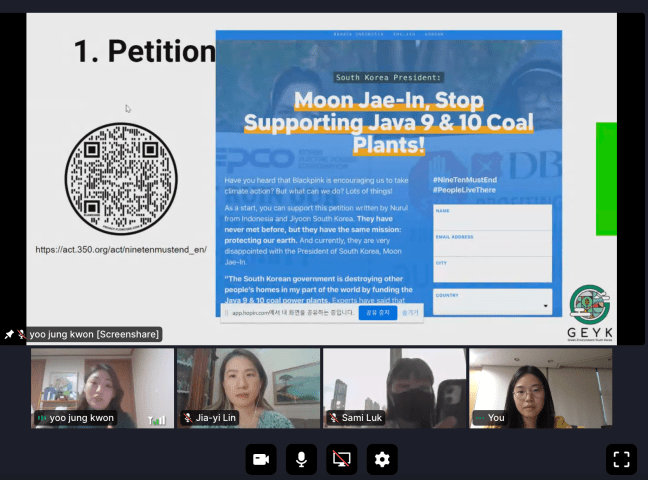
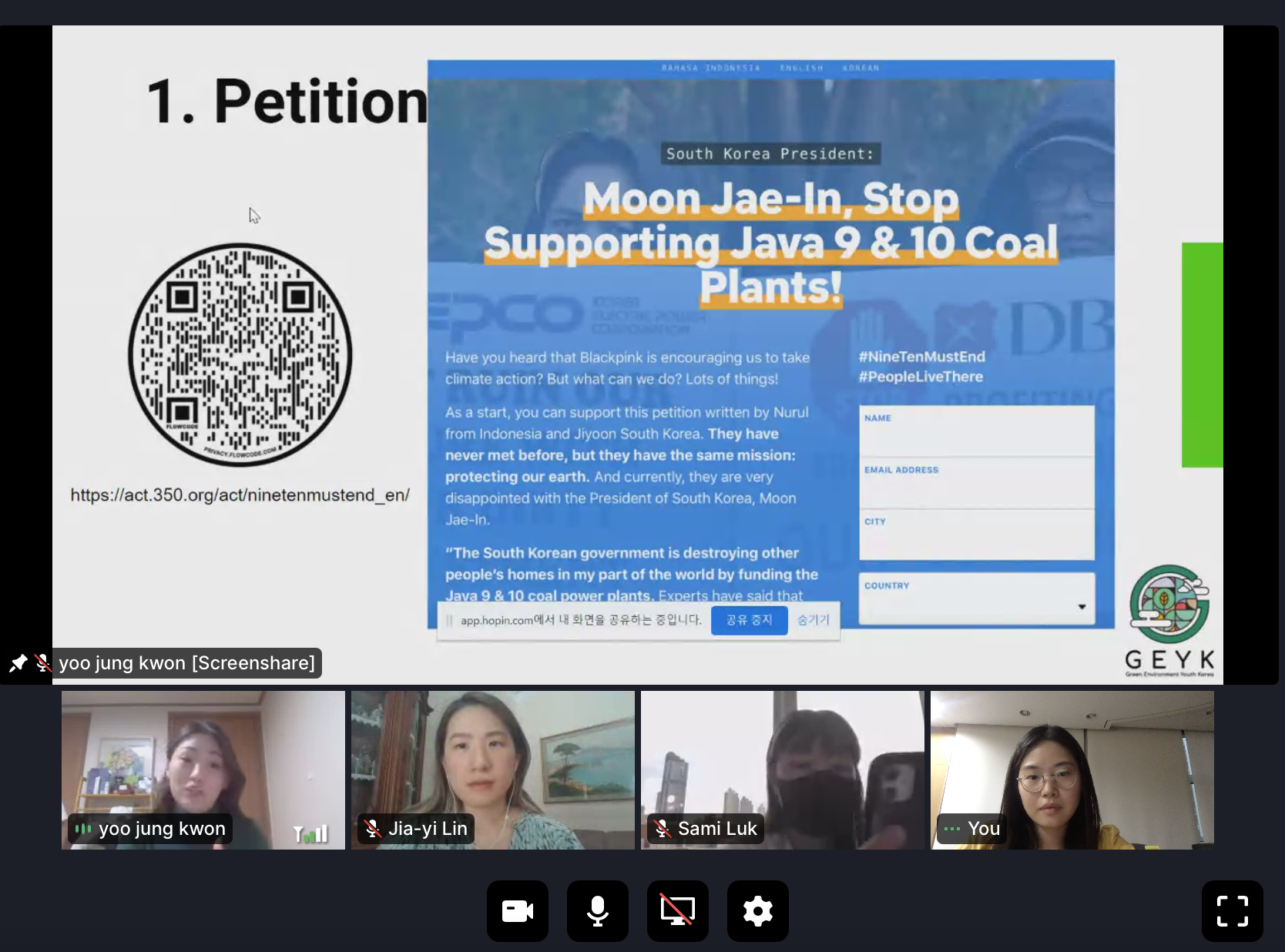
1)해당 링크를 통해 서명에 동참해주세요.
“Moon Jae-In, Stop Supporting Java 9 & 10 Coal Plants”
2)아래의 멘트를 큰 소리로 외치는 5초 분량의 영상을 찍어 GEYK의 메일로 보내주세요. ( geykkorea@gmail.com)

“Stop Greenwashing!” “Stop Coal!” “Stop Climate Crisis!”


아래는 관련 행사에 대한 자료 전문입니다.

“Greenwashing Busters” side event for Asia Solidarity Lab

The 350.org Asia organized the Asia Solidarity Lab, a 3-day virtual event built on the previous Asia Climate Leadership Camps, and Global Just Recovery Gathering in April 2021.This event aimed to engage global citizens to stand in solidarity for climate crisis. Moreover, different struggles, solutions and approaches were shared among the people, building on the momentum for the regenerative movement on climate justice.

GEYK organized a side-event session on 27 August (Fri). The session “Greenwashing Busters” brought youth from three different countries; South Korea, Taiwan, and Hong Kong to call out their major corporates who are at the forefront of the green washing movement. One of GEYK’s main value is phasing out fossil fuel, hence it is crucial to address the growing gap among corporates who are still doing business as usual despite their climate pledges. This side event was pivotal to shed light on the mounting threat of greenwash that will threaten the transition away from fossil fuels and reaching climate neutrality by 2040.

First, South Korea shared the case study of Korea Electric Power Corporation (KEPCO), the largest electricity utility in South Korea. The corporate’s green bond failed in the ESG market test, as they remain to invest in new coal power plants in Indonesia, Java 9 & 10. Next, Taiwan shared both positive and negative case studies, which Taiwan Semiconductor Manufacturing Company and Delta Electronics were recognized as leading corporates to enhance transparency for disclosure on their efforts made to reduce greenhouse gas emissions in their supply chain. On the other hand, the world’s biggest convenience store 7-Eleven was recognized to pose greenwash, sharing one of their eco-friendly products labeled as ‘trash.’ Taiwan’s case study concluded that national certifications to label the corporate’s supply chain emission level would be crucial to avoid misinformation for consumers as well as information disclosure is necessary to report the corporates ESG level. Lastly, Hong Kong shared their case study on China Light and Power Company, one of the largest power businesses in Asia-Pacific. Despite the corporates release of a Sustainability Report 2020, it was recognized that fossil fuels regardless as a stranded asset remained as the major source of the corporate’s electricity supply.

This session concluded with a collective recognition for the need of renewed credibility and urgency within major corporates to solve greenwashing threats.

Take action with GEYK!

Keyword:

Green Washing: process of conveying false impression or providing misleading information about how a company’s products are more environmentally sound

*reference: https://www.investopedia.com/terms/g/greenwashing.asp#:~:text=Greenwashing%20is%20the%20process%20of,company’s%20products%20are%20environmentally%20friendly

Green Bond: Bonds used to fund projects having positive environmental and/or climate benefits

*reference: https://www.climatebonds.net/market/explaining-green-bonds

한강 쓰레기 줍긱(GEYK)!

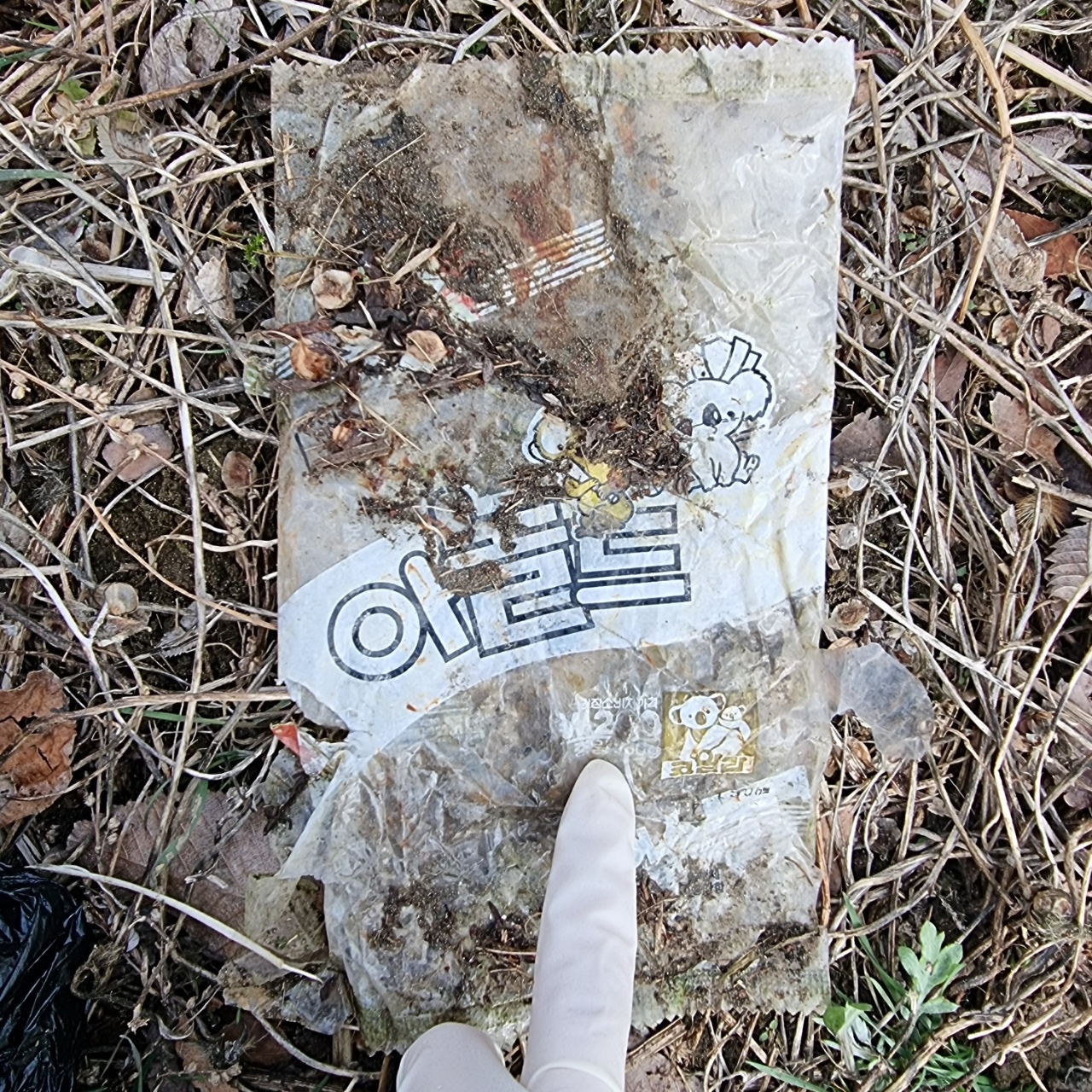
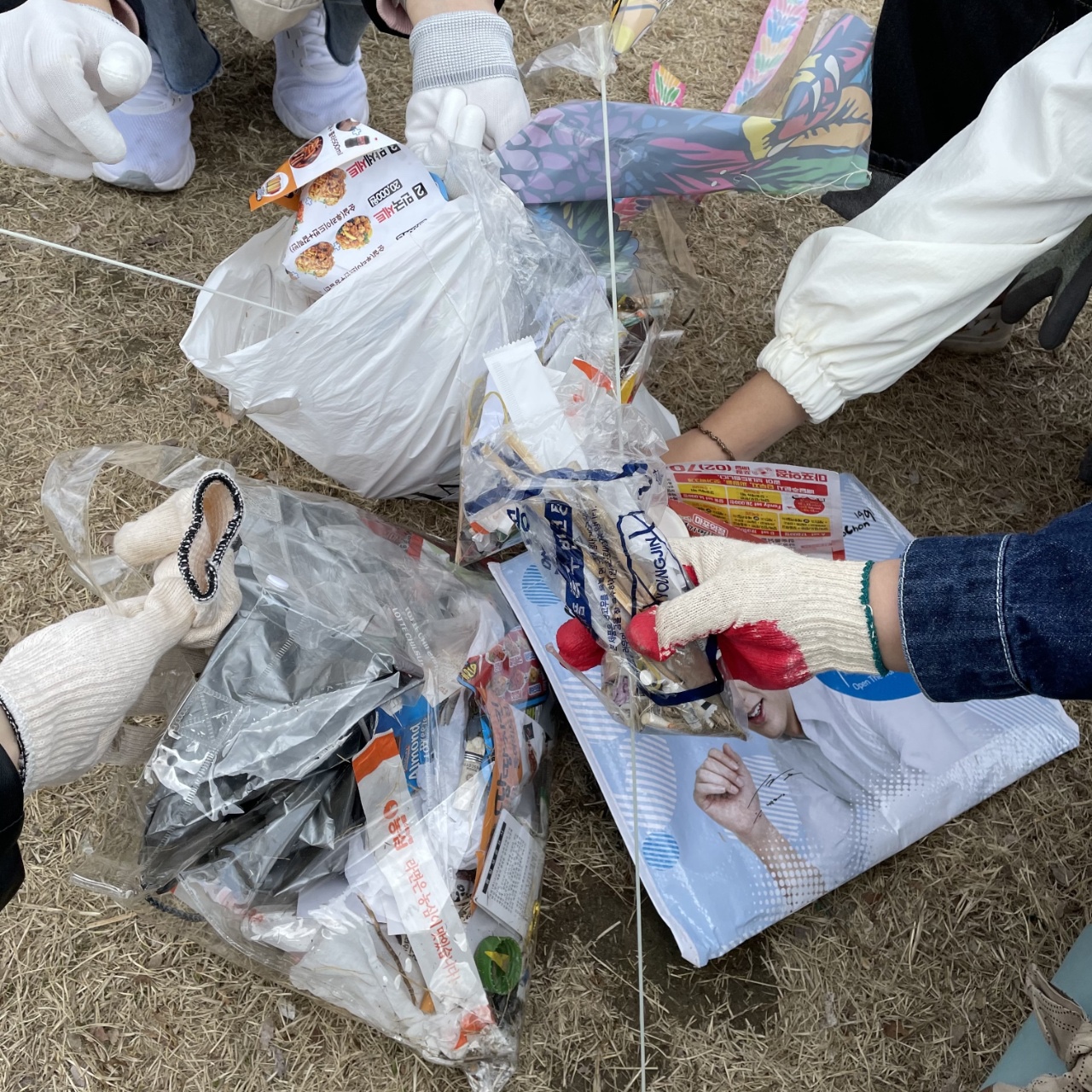
줍긱은 조직문화팀이 처음으로 기획한 활동으로 세계 물의 날인 3월 22일을 기념하여 실시한 한강 공원 플로깅 활동입니다! 희망자를 받아 사회적 거리두기 정책을 준수하여 조를 배정해 실시했고, 이틀 동안 네 팀이 약 1시간 동안 플로깅 활동을 진행했는데요, 활동을 통해 아무렇게 버려진 쓰레기들의 존재감을 느낄 수 있었고 구성원간의 친목 또한 도모할 수 있었습니다.

코로나 상황으로 인한 사회적 거리두기 정책 완화 시 줍긱 활동을 이어갈 계획입니다.

청년허브 지원사업 Global Solution lab

기후변화청년단체 GEYK은 한국이 투자한 석탄 발전소가 건설되고 있는 인도네시아와 베트남 청년들과 연대하여 그들의 이야기를 세계에 알리고자 다양한 활동을 진행하고 있습니다.

이러한 활동의 일환으로 청년허브 지원사업 Global Solution Lab 을 통해 청년들간의 국제 교류 및 협력을 활성화하는 소통의 장을 마련하고 있습니다. 인도네시아, 베트남 뿐만 아니라 세계 각국의 청년들간의 네트워크 형성과 교류를 통해 국내 및 해외에 공론화하고 기후악당으로 불리는 한국의 해외 석탄 투자 문제를 알리고자 합니다.

특히나 인도네시아 350.org 와 온라인을 통한 지속적 교류를 이어나가며 공동 액션을 위한 상호 협력방안을 모색중에 있습니다. 또한 해외석탄 화력 발전소 관련 기사 및 정책 자료집을 분석하고 온오프라인 스터디를 진행하여 발전소 투자관련 경제, 금융에 대해 토의를 진행하고 있습니다. 뿐만 아니라 생태 환경 잡지 <작은 것이 아름답다>에서 발간한 <지구를 살리는 지도-재생에너지> 책 모임을 진행하며 석탄 발전소 건설 철회를 위한 GEYK의 행동방안을 모색하며 관련 의견을 개진해 나가는 중입니다.

이외에도 해외 석탄 발전소 투자 및 건설과 관련하여 기후변화청년단체 GEYK에서는 홍익대 기후행진(2020.11.07), Asia Climate Rally(2020.11.28), 자와 9&10호기 관련 홍보 카드뉴스 제작, SNS챌린지 등의 다양한 활동을 진행하였습니다. 이를 통해 대중들에게 현 상황과 관련된 문제 의식을 재고하고 있으며 전세계적인 탈석탄 흐름에 반하는 이같은 투자활동의 철회를 위한 목소리를 높이고 있습니다.


청년허브 지원사업 Global Solution Lab OT
자와 석탄화력발전소 온오프라인 스터디

자와 석탄화력발전소 온오프라인 스터디
석탄화력발전소 철회 집회현장 방문